MathBloom › Free worksheets › Grade 2
Arrays and Equal Groups Worksheets for Grade 2
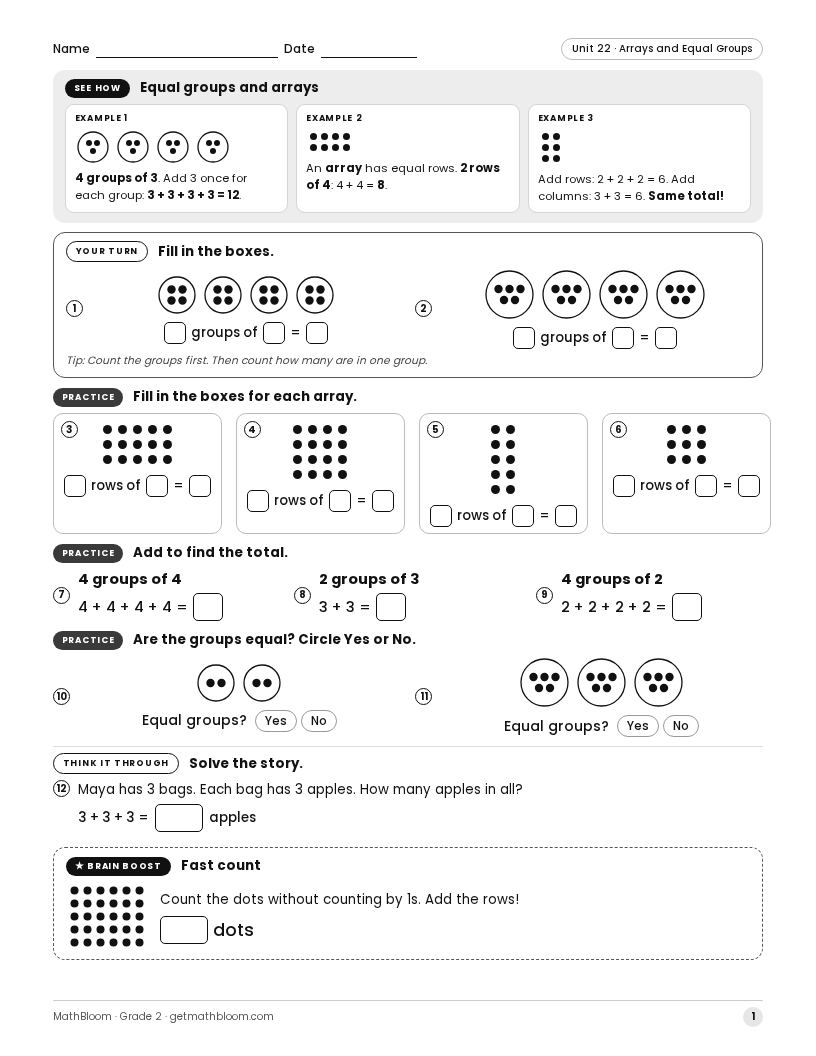
Arrays are objects arranged in equal rows and columns, like eggs in a carton. In Grade 2, children describe them with repeated addition (4 + 4 + 4 = 12), which is the doorway to multiplication.
How to teach it in 3 steps
- Find arrays at home: egg cartons, muffin trays, window panes. Count rows and how many in each row.
- Write the repeated addition: 3 rows of 4 is 4 + 4 + 4 = 12.
- Turn the array: 4 rows of 3 is the same total. This is the start of "turnaround" multiplication facts.
Common mistakes and quick fixes
- Unequal rows. Fix: line objects up in a grid before counting.
- Adding the number of rows and columns (3 + 4 = 7). Fix: add one row at a time.
- Mixing rows and columns. Fix: rows go across, like rows of seats.
Not sure this is the right level?
MathBloom's free placement check takes about 10 minutes. It shows which Grade 1 and 2 skills your child has mastered, where they are stuck, and where to start. Then practise on a tablet with every answer checked, or print the pages. For US and Canadian families; no card needed.
Start the free placement checkQuestions parents ask
Is this multiplication?
Not yet by name. Grade 2 uses repeated addition; the × sign usually comes in Grade 3.
How big are Grade 2 arrays?
Up to 5 rows and 5 columns.
What helps most?
Building arrays with real objects, then drawing them with dots.
More free Grade 2 worksheets
- Two-Digit Addition with Regrouping Worksheets for Grade 2
- Two-Digit Subtraction with Regrouping Worksheets for Grade 2
- Hundreds, Tens and Ones Worksheets for Grade 2
- Even and Odd Numbers Worksheets for Grade 2
- Mental Math Worksheets for Grade 2: Add and Subtract 10 and 100
- Telling Time to 5 Minutes Worksheets for Grade 2
- Money Worksheets for Grade 2: Counting Coins and Bills
- Addition Facts to 20 Worksheets for Grade 2