MathBloom › Free worksheets › Grade 1
Counting Coins Worksheets for Grade 1
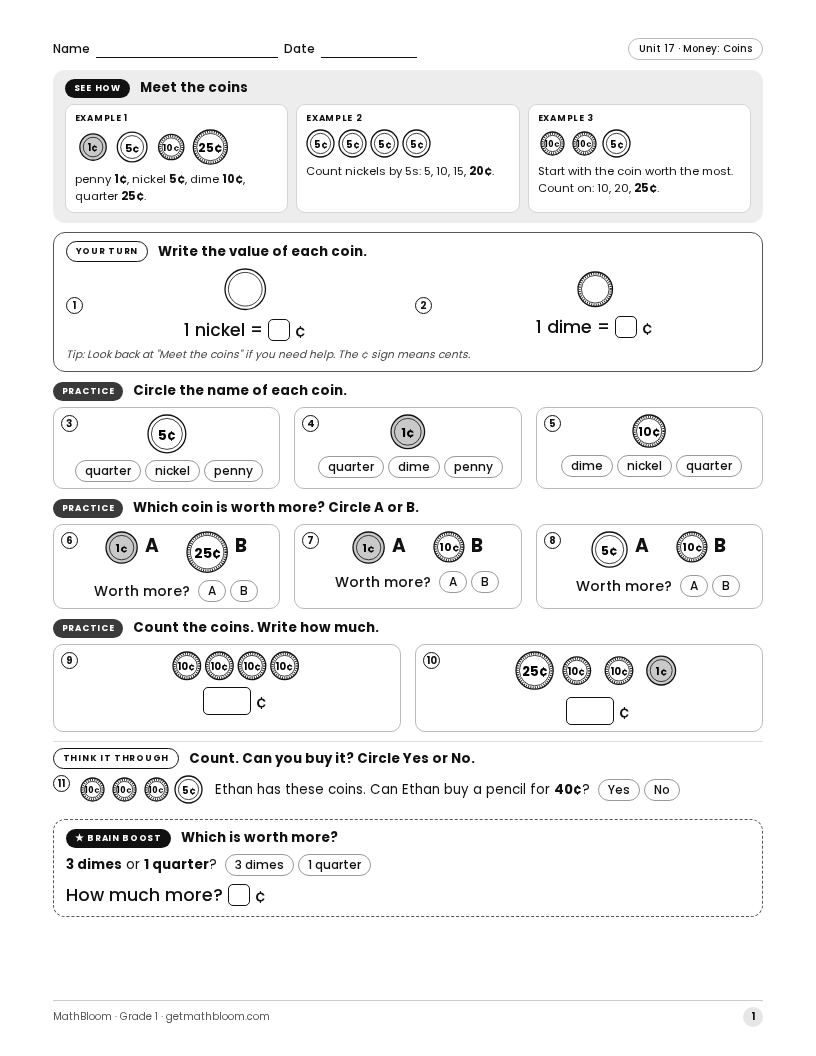
Counting coins combines three Grade 1 skills: knowing coin values, skip counting and counting on. The trick is to sort the coins first and always start with the biggest.
How to teach it in 3 steps
- Learn the values first, with real coins: in the US a penny is 1¢, a nickel 5¢, a dime 10¢, a quarter 25¢. (Canada has no penny; the toonie is $2.)
- Sort a pile by coin, biggest first.
- Count on: dimes by 10s, then nickels by 5s, then pennies by 1s. 2 dimes and 3 pennies: 10, 20, 21, 22, 23¢.
Common mistakes and quick fixes
- Thinking bigger coins are worth more (a nickel is bigger than a dime). Fix: practise values, not sizes.
- Switching counting steps too early. Fix: touch each coin as you count, and say the step change out loud.
- Counting every coin as 1. Fix: line coins up by type before counting.
Not sure this is the right level?
MathBloom's free placement check takes about 10 minutes. It shows which Grade 1 and 2 skills your child has mastered, where they are stuck, and where to start. Then practise on a tablet with every answer checked, or print the pages. For US and Canadian families; no card needed.
Start the free placement checkQuestions parents ask
Is this page for US or Canadian coins?
The printable shows US coins. MathBloom families in Canada get a Canadian edition with Canadian coins and no penny.
When do kids learn quarters?
Many Grade 1 programs add quarters late in the year; Grade 2 covers them fully.
Real coins or pictures?
Real coins first, then pictures. Children learn the look and feel of each coin faster.
More free Grade 1 worksheets
- Make a Ten Worksheets for Grade 1
- Tens and Ones Worksheets for Grade 1
- Fact Families Worksheets for Grade 1
- Addition Within 10 Worksheets for Grade 1
- Subtraction Within 10 Worksheets for Grade 1
- Telling Time Worksheets for Grade 1: Hour and Half Hour
- Halves and Fourths Worksheets for Grade 1
- Addition and Subtraction Word Problems for Grade 1