MathBloom › Free worksheets › Grade 1
Tens and Ones Worksheets for Grade 1
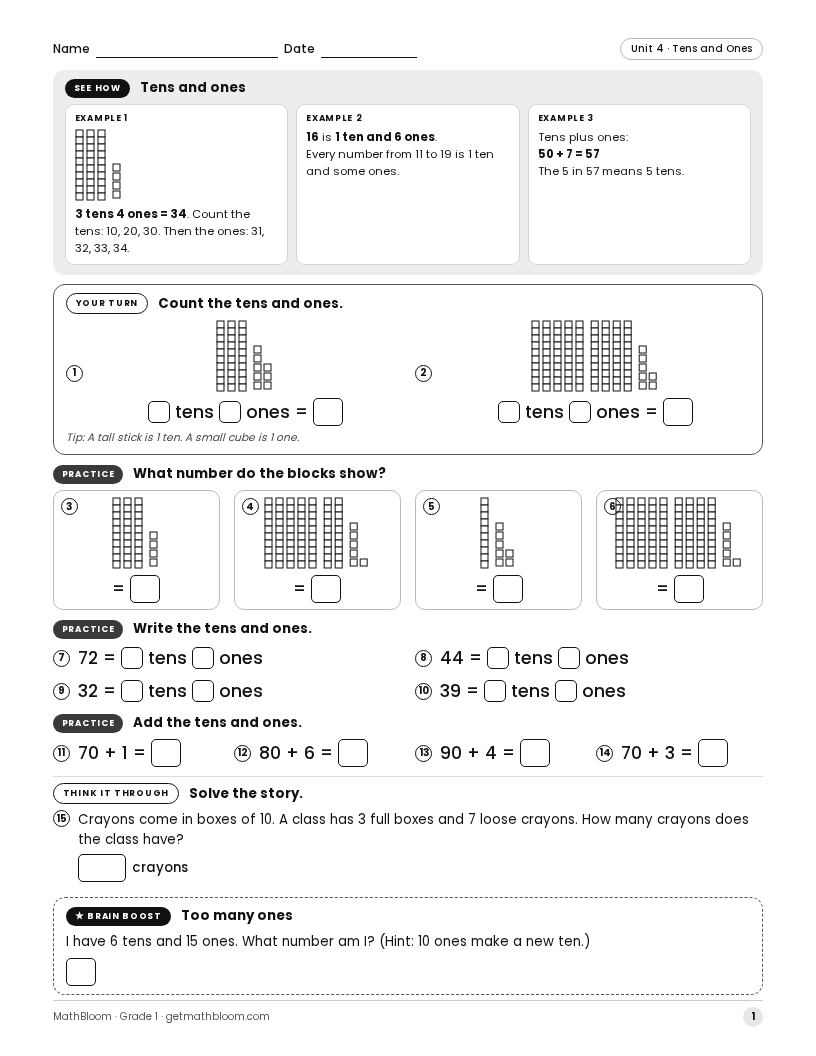
Tens and ones is where place value begins: 34 is not "three four", it is 3 tens and 4 ones. Once this clicks, adding and subtracting two-digit numbers make sense instead of being a trick.
How to teach it in 3 steps
- Bundle 10 straws or sticks with a rubber band. Show 3 bundles and 4 loose ones: 3 tens and 4 ones is 34.
- Switch to base-ten blocks or drawings: a long stick for each ten, a small square for each one.
- Go both ways: read a picture as a number (5 tens 2 ones = 52), then draw a number as tens and ones.
Common mistakes and quick fixes
- Counting each ten stick as 1. Fix: count by tens out loud first ("10, 20, 30"), then on with the ones.
- Swapping the digits (writing 43 for 3 tens 4 ones). Fix: write tens on the left, every time, in a two-box chart.
- Thinking 10 ones is not a ten. Fix: trade 10 loose ones for a bundle, often.
Not sure this is the right level?
MathBloom's free placement check takes about 10 minutes. It shows which Grade 1 and 2 skills your child has mastered, where they are stuck, and where to start. Then practise on a tablet with every answer checked, or print the pages. For US and Canadian families; no card needed.
Start the free placement checkQuestions parents ask
What number range is Grade 1 place value?
Numbers to 99 for tens and ones, and counting to 120. Hundreds come in Grade 2.
Do I need base-ten blocks?
No. Bundled straws, popsicle sticks or simple drawings work just as well.
How do I know my child understands it?
Ask "how many tens are in 47?" If the answer is 4 without counting, place value is there.
More free Grade 1 worksheets
- Make a Ten Worksheets for Grade 1
- Fact Families Worksheets for Grade 1
- Addition Within 10 Worksheets for Grade 1
- Subtraction Within 10 Worksheets for Grade 1
- Telling Time Worksheets for Grade 1: Hour and Half Hour
- Counting Coins Worksheets for Grade 1
- Halves and Fourths Worksheets for Grade 1
- Addition and Subtraction Word Problems for Grade 1